
Showing posts with label Tomme. Show all posts
Showing posts with label Tomme. Show all posts
Tuesday, 21 June 2011
Tomme #2 tasting after 4 months
I finally decided to take the plunge and taste my first Tomme. I was pretty excited about this as it was the first time I introduced Lipase to open up some of the flavours and pushing the sharpness. The pate was firm and the rind development was pretty hard to cut through. I prefer the rind to be consistently dense for maybe 3mm before hitting a nice consistence pate. This particular cheese had a more gradual hard rind development blending into the pate. The taste was slightly nutty with a creamy after taste. It was quite mild so I'm going to rewax the other half and mature for another few months to see how the flavour develops. My cave is running at 9c - 10c so affinage will be slower. This week I hope to pick up a new toy that will run my cave at 12c - 13c which will help speed things up a little..


Sunday, 10 April 2011
Tomme 1a after 2 months
This has taken a surprising turn after I thought it had gone a little sticky/slimy. Ive been washing it with brine most days and its really helped with the overall moisture and rind development. I'm going to take a sample next week so see how the flavor has development


TOMME #2 - 7 weeks
There is good rind development but only on the edges and sides of Tomme #1. I have a feeling that I may have neglected it a little as seems a little to moist in the center. Maybe more brine washes would have helped reduce the moisture content and produced a more even rind. I have now gone back to bring most days and it seems to be working but it may be a little too late in the day.


Wednesday, 16 March 2011
Tomme 1a after 3 weeks

The rind development didn't go too well with Tomme 1a. For the first few weeks it was very slimy and didn't really develop. I decided to leave it and it seems to have worked although the rind is still a little sticky in areas. This could be due to a yeast problem or maybe some kind of PH imbalance that normally occurs during brind? (this was not brined) Ill try find out what it could be.
TOMME #2 - 3 weeks
Over the past few weeks I have been washing the large 1.5kg Tomme with salt water brine with a little Geotrichum Candidum. Its started to develop a semi hard rind which I hope will continue to harden to protect the cheese. This is my first Tomme style cheese so I went for a cleaner rind rather than letting it run wild. I'm going to let it develop now, it looks like it has picked up some blue mold from my goat cheese? Ill keep an eye on how it goes. Ideally I would like a hard rind to develop over the next few weeks.


Saturday, 26 February 2011
Tomme 1a & 1b after a week
The first pressed Tomme 1a hasn't really done much over the past week. I washed it with salt brine and so far its not developed any rind or any mould. I'm sure it will over time. The surface is quite dry and rough, im not sure why. I decided as an experiment to wax Tomme 1b to see how it develops. I'm not sure if I can call this a Tomme now its been waxed..

Tomme 1a (left) & Tomme 1b (right)

Tomme 1b after waxing

Tomme 1a (left) & Tomme 1b (right)
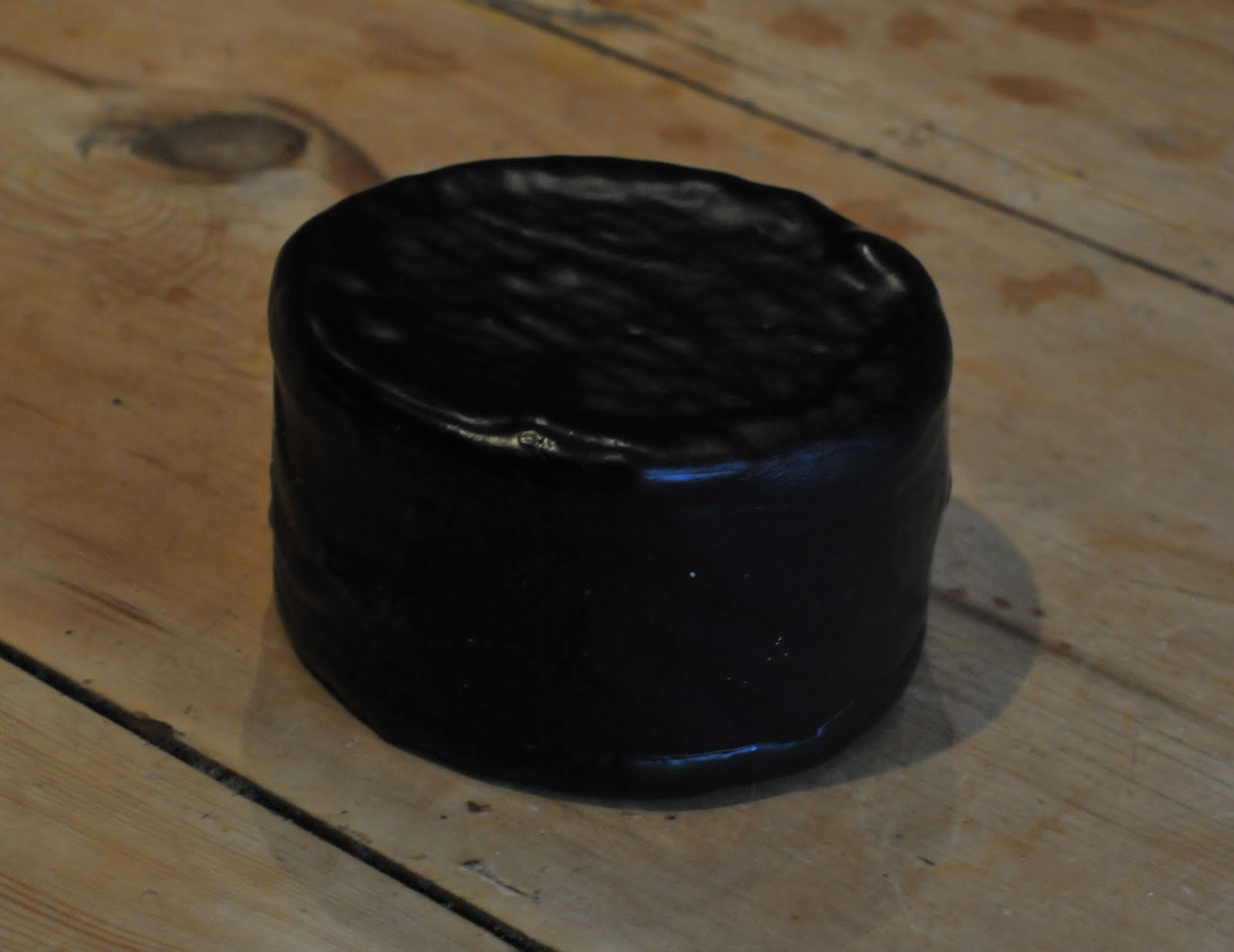
Tomme 1b after waxing
TOMME #2 - 3 days
After 2 days out I moved Tomme #2 to the cheese cave which is usually around 8c and 85% humidity. I have a number of cheeses that are being attacked by a blue mould so today I may give the fridge a good clean. I'm going to wash this in a light brine that's been inoculated with some Geotrichum Candidum. This will help develop a good rind. The plan is to keep the humidity around 90% and let it go wild for a month, then scrub it and wash in salt brine with some Marc Brandy to help develop flavour.


Monday, 21 February 2011
Tomme #2
After miss reading the Tomme recipe yesterday I decided to try again today with the other half of the Raw milk I bought from the farmers market. This time round I'm going to let it press under it's own weight. I'm also going to be more careful when it comes to cutting the curds, I felt yesterday's effort was a little rushed and the curds varied in size which isn't good for consistency. To help with cutting I decided to use a shallower but wider stockpot for easier cutting. Yesterdays was very swap so the curds at the bottom were hard to cut.
I started off hearing 2.5 gallon of milk to 32c. I added 1/4 lipase mild an then 1/3 tsp of M400 cultures. This was left to ripen for 50 minutes, 20 minutes longer than I should have so the acidity may be lower than what I needed. I also added 1/4 tsp of calcium as I read it helps to produce better curds. After 50 minutes I added 1/2 tsp of animal rennet an left for a further 45 minutes until a good cut was possible. The curds were then cut into 1/4" cubes and studded slowly to help expel the whey. I then started to hat them slowly. The why was quite clear and not too milky which shows the butterfat was retained in the curd. I also added about 3 liters of warm warmer so reduce the acidity caused by over ripening. I read it's a good idea to wash curds for a more nutty taste. The temperature hit 38 after 30 minutes. Also I forgot to mention the curds were heated to 35c before cutting, I'm hoping this didn't cause any problems. At this stage the curds looked constant in size and started to matte, I spooned them into a Tomme mould and left it to naturally press under it's own weight for 30 minutes. I then turned and left for 2 hours. I'll now turn and leave it overnight.


I started off hearing 2.5 gallon of milk to 32c. I added 1/4 lipase mild an then 1/3 tsp of M400 cultures. This was left to ripen for 50 minutes, 20 minutes longer than I should have so the acidity may be lower than what I needed. I also added 1/4 tsp of calcium as I read it helps to produce better curds. After 50 minutes I added 1/2 tsp of animal rennet an left for a further 45 minutes until a good cut was possible. The curds were then cut into 1/4" cubes and studded slowly to help expel the whey. I then started to hat them slowly. The why was quite clear and not too milky which shows the butterfat was retained in the curd. I also added about 3 liters of warm warmer so reduce the acidity caused by over ripening. I read it's a good idea to wash curds for a more nutty taste. The temperature hit 38 after 30 minutes. Also I forgot to mention the curds were heated to 35c before cutting, I'm hoping this didn't cause any problems. At this stage the curds looked constant in size and started to matte, I spooned them into a Tomme mould and left it to naturally press under it's own weight for 30 minutes. I then turned and left for 2 hours. I'll now turn and leave it overnight.


Sunday, 20 February 2011
Tomme recipe
Here is a Tomme recipe I found on www.cheeseforum.org. This is for a classic Tomme style cheese using cow or goat or sheep milk or a blend.
Mode:
http://cheeseforum.org - Linuxboy
"This cheese should have a relatively high (relative to other meso cheeses, similar to alpine styles) mineral content, meaning that calcium phosphate will not be degraded, and whey drain pH will be high (6.3+). This results in the curd sticking to each other and matting quickly. If you settle under whey too long, you will have a wheel already formed. Suggestion is to use a pot with the same diameter as the mold so you can plop it right in to the mold"
"For a washed curd tomme, follow the process through cutting, healing, but raise heat much more slowly for the first 15 mins. Target 92F, and stir gently for those 15 mins. The whey should separate enough to where you can draw off enough whey to equal 1/3 of the total milk amount. Before you draw it off, heat a volume of water that is 1/3 of the milk amount to 130F. Drain off the whey and add the heated water in two stages. Add the first half and stir gently for 5-10 mins until the curd firms up a little more. Then add the second half. Your final temp should be the same as with a normal tomme, right around 100F. Do not heat to the high end of mesophilic (105). You do not want acid production to be that fast. If concerned about temp, add the heated water in three stages so you hit 100F. Then stir the curds until they are the right texture, as noted above in the list"
"Just a suggestion....to my taste I have always preferred a washed curd tomme. It's less acidic, more plastic bodied and I have always found it to bring out the nuttiness of the milk. To wash you simply remove 1/3 of the whey before heating the curd to 100F and replace that whey with 135F water (raising total temp to about 100F). The rest of the recipe is the same. I'm thrilled to see someone else using flocculation, I have had heated ebates in the "industry" about this. Automation and large scale production seems intent on making everything set times, but with variable milk supply (like here in NZ) it's impossible to do that and get consistent result. With that said 3 is a great multiplier for Tomme, most of the time. If your wheels can't hold their shape cut the multiplier in half and go from there. If you make the cheese often you can try and extend the multiplier and see how far you can go to get the ideal moisture content of the curd"
Mode:
- Warm 2 gallons milk to 32c
- add 1/4 tsp MA400
- Ripen for 30 mins at 32c
- Add CaCl2 diluted in cold water
- Add 3/4 tsp of animal rennet dissolved in 1/4 cup distilled water
- After 45 minutes cut curds into 1/4 " cubes and let it heal for 10 minutes (preventing matting)
- While stirring increase temperature to 38c over 30 minutes. Hold at 38c until the curd is at the right texture. You can tell this by pressing This can be checked by squeezing some curds in your hand. If the curd matts it's ready, if it breaks, leave for a few minutes and try again.
- Drain in a mould (pH should be 6.35 or higher) and let it press under its own weight turning every 30 minutes, then every hour for 5 hours.
- Press overnight or until pH is 5.4
- Brine in 20 % saturated bring for 8 hours turn after 4
- Leave at room temperature. Once dry move to the cave and leave to age for 3-6 months at 10-12c, 85-90% (or higher if using special b linens)
http://cheeseforum.org - Linuxboy
"This cheese should have a relatively high (relative to other meso cheeses, similar to alpine styles) mineral content, meaning that calcium phosphate will not be degraded, and whey drain pH will be high (6.3+). This results in the curd sticking to each other and matting quickly. If you settle under whey too long, you will have a wheel already formed. Suggestion is to use a pot with the same diameter as the mold so you can plop it right in to the mold"
"For a washed curd tomme, follow the process through cutting, healing, but raise heat much more slowly for the first 15 mins. Target 92F, and stir gently for those 15 mins. The whey should separate enough to where you can draw off enough whey to equal 1/3 of the total milk amount. Before you draw it off, heat a volume of water that is 1/3 of the milk amount to 130F. Drain off the whey and add the heated water in two stages. Add the first half and stir gently for 5-10 mins until the curd firms up a little more. Then add the second half. Your final temp should be the same as with a normal tomme, right around 100F. Do not heat to the high end of mesophilic (105). You do not want acid production to be that fast. If concerned about temp, add the heated water in three stages so you hit 100F. Then stir the curds until they are the right texture, as noted above in the list"
"Just a suggestion....to my taste I have always preferred a washed curd tomme. It's less acidic, more plastic bodied and I have always found it to bring out the nuttiness of the milk. To wash you simply remove 1/3 of the whey before heating the curd to 100F and replace that whey with 135F water (raising total temp to about 100F). The rest of the recipe is the same. I'm thrilled to see someone else using flocculation, I have had heated ebates in the "industry" about this. Automation and large scale production seems intent on making everything set times, but with variable milk supply (like here in NZ) it's impossible to do that and get consistent result. With that said 3 is a great multiplier for Tomme, most of the time. If your wheels can't hold their shape cut the multiplier in half and go from there. If you make the cheese often you can try and extend the multiplier and see how far you can go to get the ideal moisture content of the curd"
Tomme #1a & #1b
I went to the farmers market today and bought 4 Gallon of raw milk. On the walk back I decided to make 2 gallon into a Tomme style cheese. Tommes are usually low in fat as they are produced from the skimmed milk left over after the cream has been removed to produce butter.
To start I heated the milk to 32c and added 1/8 tsp Lipase milk and 1/8 tsp of Calcium Chloride and let it stand for 15 minutes. I then added 1/4 tsp M400 starter and let it ripen for 30 minutes. Once ripened the PH would have dropped a little, I then added 1/4 tsp animal rennet diluted in water and gave it a genital stir for a minute and left it to coagulate. Ive yet to try the flocculation technique but I need to feel more confident in doing so. Maybe Ill do it on tomorrows batch? Once I got a good cut, I think it took around 40 minutes I then cut the curds into 1/4" cubes. The coagulation time for Tommes should be around 30 minutes so the acidity may me a little too high? Maybe next time Ill use a little more rennet. once the curds were cut I then continued to stir to prevent matting, the idea is to now raise the temperature to 38c over 30 minutes to expel more whey from the curds. I have decided to wash the curds as I read that reducing the acid in the whey gives a more nutty and slightly plastic feel to the cheese. I replaced 1/3 of the whey with warmer water over 20 minutes to raise the temperature to 38c. This was meant to take 30 minutes so I just stirred for 10 minutes to make up the time. After leaving the curds to settle I spooned them into my press. Tommes are usually left to press under their own weight but I miss read the recipe. I only pressed it very lightly so I just left it, after 3o minutes I undressed it from the cloth and repressed again at a very light weight. The remaining curds were left to press under its own weight naturally.
 Curds ready to cut
 Curds straight after cut
 Curds after 30 minutes of heating to 38c
 Curds in press
 Left over curds left to press naturally
Subscribe to:
Posts (Atom)